The Marriage Charter of Empress Theophanu
Politics and Power: The Marriage Charter of Empress Theophanu
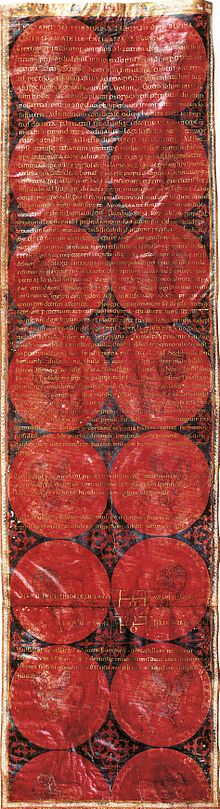
The marriage charter detailed the territories that Theophanu would receive for her “faithful and obedient hand in marriage” (Garrison 212). In preparation for the marriage and prior to the ceremony, the husband would transfer the bride price, or dos, to the bride. The marriage charter was also like an endowment document with which Otto handed his wife her dos (Reudenback 15). She would gain power of disposal over certain provinces and imperial estates which would be beneficial for the Byzantine Empire. This document also would serve as a way to introduce Theophanu as the wife of Otto II. The charter would be displayed and read aloud at key stops on the imperial itinerary as they traveled from Rome to the Ottonian kingdom.
This marriage uniting the Byzantine and Ottonian kingdoms had been in the works for a while. Otto I had originally wanted his representatives to negotiate a marriage between his son, Otto II, and Anna, Byzantine princess and daughter of Byzantine emperor Romanos II, but was not able to convince the Byzantines to agree. Due to this long process of negotiations, a version of the marriage charter could have been started before Otto II and Theophanu were officially engaged in anticipation of a marriage between Otto and Anna. Because the document is very elaborate and artistically sophisticated, scholars such as Reudenback postulate this theory and the idea that there could have been a simpler original document that was written up beforehand (Reudenback 16).
While there is some doubt as to whether the document that we possess is the “real” thing or a copy of the original, it is regardless very rich, containing both striking text as well as vivid colors and expressive pictures. In the ninth century it was also believed that special and more elaborate forms of writing and graphic signs made these documents tools of displaying prestige and of symbolic communication (Reudenback 17). The marriage charter, then, wasn’t just to make the wedding of Otto II and Theophanu official; it was also a way to show their wealth and influence. The Ottonian emperor gathered multiple artists and writers to collaborate on the marriage charter, demonstrating the large amount of power and influence he possessed. Due to this complexity, the marriage charter has been the topic of many scholarly studies, the first of which was published in 1707 (Cutler and North 167). Since then, many historians and scholars have analyzed this document and used it to try to better understand the Ottonian and Byzantine kingdoms and their relations at this time. A greater understanding of the importance of this document can emerge by analyzing its creation, as well as both its textual and visual elements, and putting them in context with Ottonian-Byzantine relations in the 900s.
The Charter: Creation and Design

Ultimately, though, this charter was made for an Ottonian emperor to give to his bride, and therefore has primarily Ottonian influences. There are Byzantine elements in the appearance, but they are more superficial. The Byzantine and Ottonian influences on the charter will be discussed further in the next paragraphs regarding how the charter was actually made. Scholars are still debating whether the artistry of the scroll and the text are interconnected. Anthony Cutler and William North, historians that work with medieval studies and art history, in their joint study of the marriage charter, concluded that the relationship between the object's imagery and text is coincidental. Eliza Garrison, however, takes the opposite view, suggesting that this relationship is purposeful. Anton Von Euw, another scholar who has studied the marriage charter, believes that the object also seems to be derived from Syriac textiles and sculptures (Garrison 220). He believes that the iconographic sources have the ultimate purpose of glorification of the ruler. In this case then, it would be to glorify Otto and Theophanu and their marriage that united two kingdoms.
A silk imitation was used as the main material of the body of Theophanu’s marriage charter. Using a silk imitation instead of other materials is important as silk, at the time, could only be found in the Byzantine Empire, so the ability of the Ottonians to make a silk imitation that was close to real silk demonstrates the wealth that the Ottonians had. This document started off as three separate pieces that were eventually glued together, before being painted purple on both sides. The front side’s pigment had a special effect as it was made with both madder and minus, while the back side’s pigment was made with only madder. Madder and minus are pigments that were used to dye materials in the ancient world (Newman and Gates). This simulated the effects of murex purple dye, something that cannot be found in the west and was restricted to only being used for luxury goods for the Byzantine emperor, incorporating Theophanu’s Byzantine roots.

While some scholars have conducted comparisons to other documents like Italian liturgical scrolls, none of these documents are exactly the same. The techniques used to create this charter are unique and special to this particular document as no other charter exists that is similar to what was used with this marriage charter, indicated previously with the explanation of the silk imitation and the special effects of the text. A reason for the uniqueness of this particular document could be the influence that Theophanu’s Byzantine identity had on the creation and final version of the document. The charter seems to combine Theophanu’s Byzantine identity with signs of local Ottonian influences throughout the document. While the exact location of its creation is debated upon, if the charter were created by the subjects of the king and queen then it would hold further significance as a creation made from the people that the monarchs will rule over together.
The Marriage Charter: Purposes
There is intense debate among scholars about the various purposes of the marriage charter. The most obvious one is its purpose as a legal document that unites Otto II and Theophanu and their corresponding kingdoms. The marriage of the two was conducted after a period of conflict and diplomatic tension between the Ottonians and the Byzantines, primarily over land disputes in southern Italy. As stated earlier, Otto II was actually originally intended to marry Anna (963-1011), daughter of the Byzantine emperor Romanos II, but Otto I adapted after his retinue returned with Theophanu, niece of John Tzimiskes, another Byzantine emperor, instead. Their marriage was largely, at least initially, a political move in order to ease tensions and a strategic play by Otto I to gain important imperial connections for the Ottonians, and hence raise their own status (Cutler and North 185). However, while there are certainly broad implications for how the marriage charter was used, there are also several theories by different scholars about its purposes that derive from various interpretations of the charter’s specific qualities. Anthony Cutler and William North explain several of these theories.
One reading of the document has been presented by Dieter Matthes and Walter Deeters, German historians and medievalists. They claimed the charter was a visual expression of the imperial court at a time in which it was trying to heal the rifts between the Byzantines and Ottonians. They proposed that this charter was a way to bridge the gap between the two groups, and that it was specifically done in a way to flatter and please the Byzantines with the text and illustrations used on the document. One example of such flattery includes the prominence given to the fifth and eleventh roundels on the charter. Whenever the charter was distributed, it was done so that each section had four of the roundels on it. It was noticed that in the final section, the line- and word- count correspond to five and eleven, which could be a reference to the birthday of Constantinople, May 11th.
This flattering of the Byzantines can also be seen in how the dominant animals and the submissive animals—located on the roundels—seem to be getting along. The submissive animals, usually prey animals like cows, are offering themselves to the dominant animals, usually predator animals like lions. The dominant animals also seem to be holding the submissive ones affectionately (Cutler and North 173). It is claimed that this is representing a newly amicable relationship at court. Another interpretation is that Theophanu is the one who primarily drafted what her charter would visually look like. Unsatisfied with the inadequacy of the standard Ottonian product, she requested Byzantine touches be added to insert herself and her home into the narrative.

Some scholars, however, have argued that the charter was used as a subtle way to assert superiority over the Byzantines. Werner Ohnsorge, a German Byzantologist and archivist, reported that many magnates, as well as Otto I himself, were likely slighted by the offering of Theophanu instead of Anna, their original request. While they accepted Theophanu as a way to form positive relations with the Byzantine and not cause conflict, they used “subtle slights” and “loaded language” (Cutler and North 174), that were added with the intent to put Theophanu in her place and restore the supremacy of the Ottonians after the humiliation of rejection. In this reading, the charter itself embodied the tension and hostility that characterized the courts before the marriage.
Another use that is widely acknowledged is the many ways it solidified both religious and imperial power. Hartmut Hoffman, a medieval historian, and Hiltrud Westermann-Angehausen, an art historian, argued that the charter was an important imperial project, and that its patrons and creators fully intended it to be an instrument of public communication through which to indicate the quality of the marriage between Otto II and Theophanu and emphasize their power (Cutler and North 175). For example, many aspects of the charter relate back to ideas of religion, which is often used as a mechanism to legitimize a ruler. One way the charter does this is through the text of the document itself. For example, the charter explains how God created the natural order of things and then created wives so that men would not be alone. It also emphasizes the importance of marriage and states that it should be celebrated in a legitimate and holy manner. Furthering this religious and imperial theme, the document states that those faithful to the Church and to Christ will be faithful to Otto and Theophanu and their marriage, and consequently also their empire (Monamenta). Aside from the actual text of the document, many other aspects of it also reflected an imperial purpose.
Both the actual material of the charter and how it was communicated to the public strongly suggest that it was used for imperial purposes. As stated earlier, the charter is made out of a silk imitation, which was frequently used in sacred contexts due to silk’s rarity and the desire to emulate a material that is considered rare and valuable (Garrison 220). Silk was also often used to wrap relics because it was deemed worthy to contain and protect saintly remains. Additionally, silk was often used as a diplomatic gift in Byzantium at this time. Therefore, the use of silk imitation for this charter implies the pushing of an imperial agenda due to its religious and political connections. The imitation silk being dyed purple also highlights imperial power; purple dye was expensive and rare, and only destined for the use of the emperor.
Otto I arranged the marriage between his son and a Byzantine woman to quell conflict between the two kingdoms, as well as to legitimate the Ottos’ realm as an empire in its own right, so the proclamation of his son’s marriage had to be effective. The references to Christendom and diplomatic politics, seen with the imitation silk, expensive dye, detailed illustrations, and text, all work for this purpose. The size and the text of the charter also imply it was likely designed to be handheld, as opposed to spread over a table or hung on a wall, and was paraded around to various parts of the empire (Cutler and North 170). This is further evidence that it could have been used to spread imperial power and to ease any fears or misdoubts about Theophanu’s ascension to the Ottonian throne. The charter itself was arguably of particular importance to her and her legitimacy as empress.
Theophanu and Her Queenliness
This marriage charter is queenly because it is a physical embodiment of the expectations for noble women. Imperial women, whether they were princesses or relatives of rulers, were often used as pawns in strategic marriages. They were expected to be married off to different empires in order to foster political unity between two kingdoms or to avoid conflict. In our particular case, Theophanu and Otto were married off to prevent conflict between the powerful kingdoms, both of which wanted control of what is present-day southern Italy (Garrison 225). Queens also could convey legitimacy and claims to rulership through their spouses as well as their offspring. As we have seen, Otto II originally wanted to marry Anna, the Byzantine emperor’s daughter, but wasn’t permitted to do so. Anna was considered a purple-born daughter and marrying her to a European court could pose a threat to the line of Byzantine succession in the future (Garrison 225). Purple-born was a term used to denote a child born to the royal family while their parents reigned. This could partially be why Otto married Theophanu, rather than Anna. Sending Theophanu was also dangerous for the Byzantine Empire because it could have been seen as an affront to Otto’s honor. This could have intensified the long-standing political antagonism between the two houses.

This charter also can be considered queenly based on what it did for Empress Theophanu, who ruled with her husband until his death in 983. The death of her husband set up their son Otto III to become the next emperor, but he was only three years old when his father died. As a result, Otto III required a regent to rule for him until he came of age, a role that was fought over between multiple people, including Duke Henry of Bavaria and Otto’s own mother, Empress Theophanu. The marriage charter between Emperor Otto II and Empress Theophanu, along with the parental role that Theophanu has in the life of Otto III, gave her legal authority to assume the role as regent of the kingdom until her son came of age. While serving, Empress Theophanu served as a cautious leader, making sure to not disrupt the systems in place due to her status not only as a woman, but a Byzantine woman within a foreign kingdom. Even with her cautious nature in ruling, Empress Theophanu was able to consolidate power and rule with the authority and confidence necessary for the role.
The text of the charter itself and how it was used to grant Theophanu more power also emphasize her queenliness. While the charter did contain some examples of language that placed women below their husbands, there were also several instances in which it illustrated Theophanu’s power as an empress. The charter writes that her legitimacy in her marriage is through God, and that a certain divinity lives in her that makes her capable of ruling and having some amount of autonomy (Monumenta). One aspect of this autonomy is the land given to her in the charter, which granted her some amount of political freedom as well as some amount of power and influence among local aristocracies and allowed her to act as a patron in her own right. The charter also emphasized that she was one of the leaders of the imperial house, essentially empowering her to act as a guardian of Ottonian memory by being the mother of emperors and the person through which the future heirs to the Ottonian kingdom will come from. This inherently gives her power, especially when considering her role as regent for her son, Otto III. Additionally, since the charter was used to showcase imperial power and communicate the successful union of Otto II and Theophanu—both when the charter was read at several spots in the kingdom and when the empress was presented at court—she gained legitimacy as a ruler through these proceedings. The charter was essentially used as an instrument through which to enhance Theophanu’s queenliness.
Conclusion
While aspects of the document emphasized the role that the male traditionally holds within a relationship, the way that this charter was used ended up diverging from these tropes of male dominance and led to the dominance of a female within a role typically held by men. Empress Theophanu’s marriage charter is, in short, a queenly document, made to honor her both as a wife to Otto II and as Empress.
Bibliography:
Cutler, Anthony and William North. “Word over Image: On Making, Uses, and Destiny of the Marriage Charter of Otto II and Theophanu.” Interactions: Artistic Interchange between the Eastern and Western Worlds in the Medieval Period, ed. Colum Hourihane, Pennsylvania State University Press, 2007, pp. 167-187.
Garrison, Eliza. “Mimetic Bodies: Repetition, Replication, and Simulation in the Marriage Charter of Empress Theophanu.” Word & Image, vol. 33, no. 2 (2017), pp. 212-232, https://doi.org/10.1080/02666286.2017.1304796.
Hill Jr., Boyd. Medieval Monarchy in Action: The German Empire from Henry I to Henry IV, Barnes and Noble, 1972, pp. 163-165.
Maclean, Simon. “Theophanu and the ‘Dominae Imperiales’, 971-91.” Ottonian Queenship, Oxford University Press, 2017, pp. 150-179.
Monumenta Germaniae Historica, Diplomatum regum et imperatorum Germaniae 2/1, ed. Theodor von Sickel, Hannover: Hahn, 1888, pp. 28-29.
Newman, Richard, and Glenn Alan Gates. “The Matter of Madder in the Ancient World.” Mummy Portraits of Roman Egypt: Emerging Research from the APPEAR Project. J. Paul Getty Museum, Los Angeles, August 25, 2020. https://www.getty.edu/publications/mummyportraits/part-one/3/.
Reudenbach, Bruno. “The Marriage Charter’ of Theophanu: A Product of Ottonian Manuscript Culture.” Manuscript Cultures, no. 10 (2017), pp. 15-31.
Comments
Post a Comment