Theodora and the S. Vitale Mosaics
 |
| Figure 1. Am image of the outside of S. Vitale in Ravenna, Italy. |
San Vitale, often labeled S. Vitale, cuts an impressive figure. A church, located in Ravenna, Italy, it is surprisingly intact for a structure about 1,500 years old. Bishop Ecclesius of Ravenna, an important member of the Byzantine Christian hierarchy, began the building of the church in 526, although it was not consecrated until 547. Originally dedicated to Ravenna’s patron saint martyr Vitalis and designed to mimic similar structures at the important Byzantine city of Constantinople, it was primarily meant to evoke both religious and political imagery important to the Byzantine Empire at this time.
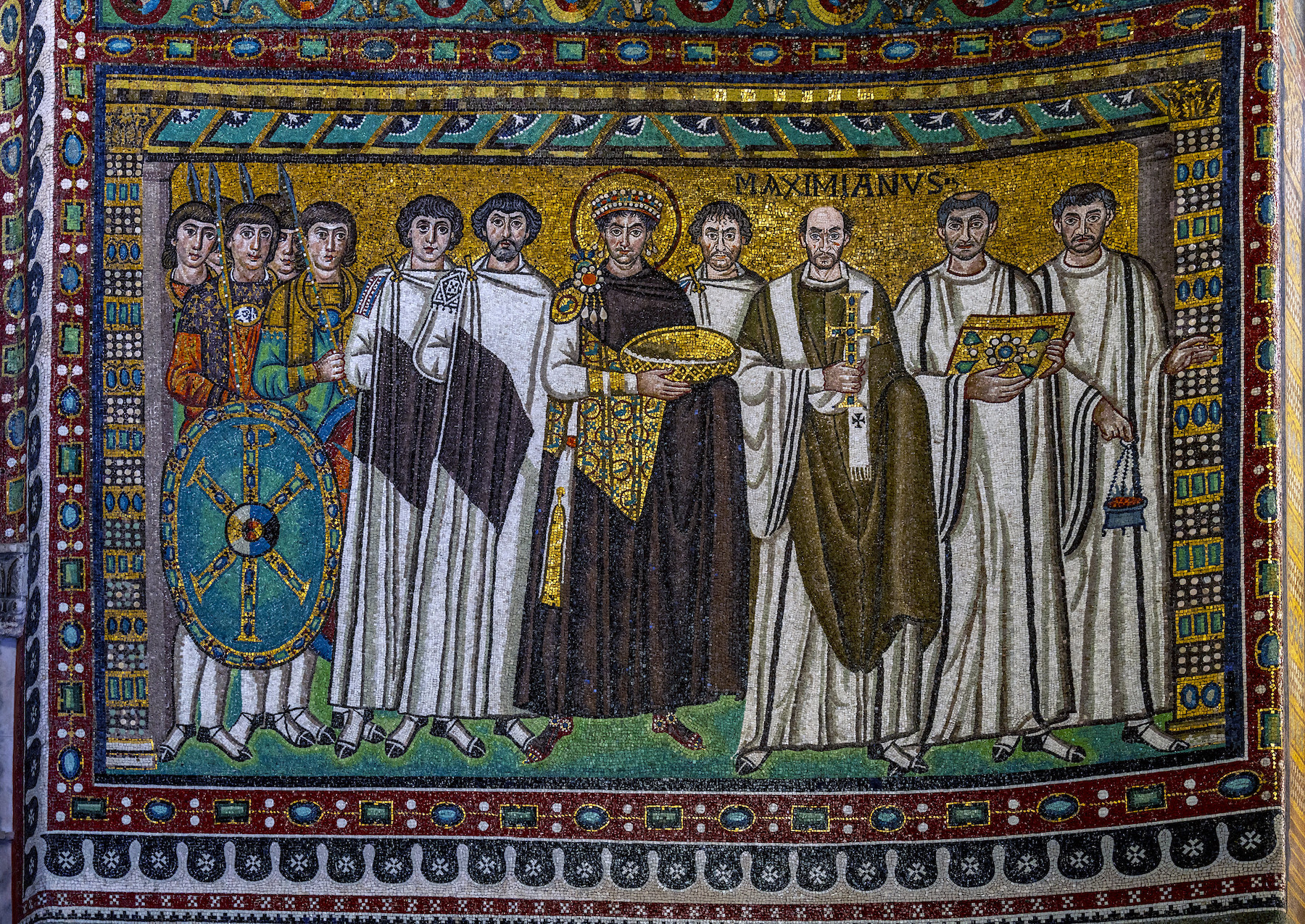
While the entire church has served as a way to evaluate early Christian Byzantine art and architecture, its most impressive feature is a set of mosaics that decorate much of the interior walls and ceiling. The mosaics depict Justinian I and Theodora, an emperor and empress of the Byzantine Empire in the sixth century, as the leaders of an imperial, and religious, procession. The details of these figures, as well as those of their entourage, provide information about their ages, professions, and connections to the imperial power of the emperor and empress. Despite the building of the church dating back to 526, the mosaics decorating the inside of it are dated between 546 and 556, after Bishop Ecclesuis was succeeded by Maximian. Following the theme of a representation of both religious and imperial power, the most prominent figure in the mosaics, aside from Justinian and Theodora, is Maximian himself. Emperors and popes alike sought to appoint their own men to Maximian’s position, which numbered among the most important in a city such as Ravenna, which was attempting to gain more political, social, and cultural importance. Several other figures, most likely aristocrats, guards, and servants, are also present.
Not only are these pieces some of the only known portraits of Justinian and Theodora, they also indicate the important introduction and legitimizing power of religious and political figures in mosaics in early Christian empires. Byzantine politics, cultural traditions, and religious developments have been uncovered by historians through a careful analysis and interpretation of S. Vitale and its history. An examination of the mosaic can also reveal much about how Theodora, and other empresses in the early Christian Byzantine Empire, wielded their power.
 |
| Figure 2. A view of the interior mosaics in S. Vitale. Both the ceiling and wall mosaics are visible. |
The Design and Technique of the S. Vitale Mosaics
 | ||||||||
Figure 3. Comparison picture taken from a mosaic at the Holy Church of the Virgin Mary Angeloktisti at Kiti, another early Christian Byzantine church. This shows how important tesserae placement was as it could portray different images based on the lighting. S. Vitale’s Intended Audience, Message, and ConsequencesThe main purpose of the mosaics in S. Vitale is hotly debated by various scholars. One interpretation offered is that the intended audience of this mosaic were the people of Ravenna who had been previously conquered by Orthogoths, a Germanic people who invaded Byzantine land in the 6th-century, here depicted as barbarians and heretics. Since the Byzantines had embraced Christendom, establishing that the emperors were aligned with God would make the people of Ravenna fear questioning their rule. The mosaic features emperor Justinian and empress Theodora each under the apse of a church. In this way, the artwork works to reinforce the recurring theme throughout S. Vitale of offering and kingship. Justinian and Theodora are depicted with halos above their heads, representations of the idea that rulers were descended from God. Justianian is holding a golden paten bearing eucharist bread, and Theodora is carrying a chalice with wine for offering. While the exact significance of the objects they are carrying is still debated, scholars seem to agree that they are participating in a religious ceremony. This emphasizes the image that the royal court is in communion with God and that they were chosen to lead by God. The placement of this artwork in a church and the materials used also indicates that they were trying to align themselves with God. Gold and silver were chosen as the materials for this mosaic because they would better reflect the light that was sent from God. As the rulers, the mosaic seems to really be emphasizing that Theodora and Justinian are the intermediates between the viewers and the divine.
Others argue that the mosaics were instead, or perhaps also, made with a politically legalizing intent. The city of Ravenna, where the temple was built, was a crucial town in the Byzantine Empire. It had been recently regained from the Ostrogoth by Justinian through military victory, and it was an important political center. At the time of the mosaic's creation, emperor Justinian was using Ravenna as a base for campaigns in order to regain the rest of Italy; and, since Ravenna had been reintegrated into the empire, this mosaic was a way to further elevate its status and legitimize its belonging by stressing the city's political, social, and culture relevance within the Byzantine Empire. Such an expensive piece of artwork to be made in the city of Ravenna indicated that the rulers believed it to be a crucial part of the empire.
Diverging from these views is the interpretation of the mosaics as having a politically manipulative purpose on the part of the consecrating bishop, Maximian, who sought to emphasize his connections to the emperor and express at a time when that relationship was somewhat contested, or unknown, in Ravenna. S. Vitale was not originally Maximian's church, but he took over the project after his predecessors. He would eventually consecrate the church, with some scholars arguing that he is the only figure explicitly labeled in Justinian's mosaic, an interesting facet of the artwork considering not even Justinian and Theodora are presently labeled, because he changed the original image to include himself, and wanted his presence to be known. Maximian wanted to emphasize the power of the emperors during a period of unrest, while also making extremely clear his own ties to the presumed power and legitimacy of Justinian and Theodora. In this way, Maximian projected a sense of authority and power through the image, impressing his contemporaries and establishing his importance for future observers. Empress Theodora and Queenliness in S. VitaleThe mosaic, in addition to representing imperial, political, and religious power, has many qualities that make it queenly in nature and showcase how Theodora exercised her authority. This is suggested most obviously through the materials used in the creation of the mosaic. One of such materials that strongly relate a queenly quality is gold. While gold in art had become more widespread in the early medieval period, this material was still incredibly valuable. The extensive amount of gold used in this painting, then, indicates the enormous wealth and importance of the project. Aside from the gold indicating luxury that befits royalty, however, it is often related to Byzantine queens also because it reflects one of their primary methods of wielding power. A queen might not have had the outright power that a king did, but they had the access to gold that could be used to fund what the queen believed to be important. This could be the funding of mosaics and churches, and also other key responsibilities like helping the less fortunate. The use of gold in the mosaic is also extremely indicative of queenliness due to the connection it has with religion, another important duty of Byzantine queens and an important aspect of Theodora’s reign as empress and her queenly identity. Gold material was often associated with Christendom because it was said to literally reflect the power of God that came down to the Earth through light, with the light that was shown through the gold material being a metaphor for God’s light and power. The amount of gold in the mosaic in S. Vitale, then, represents queenliness because it literally was considered a reflection of God. The power of the gold in the mosaic, then, brought the viewer in the church closer to God, which was viewed as a responsibility of the emperor and empress.
The mosaic is also queenly because it emphasizes the power of female rulers. As the empress, Theodora was the leader of the female court. Her responsibility as queen was to preside over a ritual for the elite females. Because of their relationship with the emperor, the empress was given elevated status. Female courts weren’t just a shadow of male institutions; rather, they had their own distinct identities. The female court was called the sekreton ton gynaikon and they had their own hierarchical system. The head of the female court below the empress was the zoste patrika or “mistress of the robes”. This officer was typically appointed by the emperor, and more often than not was related to the empress. Her status was both functional and ceremonial. Being high ranking in the female court also translated to power in the general court. The zoste patrika was one of six dignitaries that were invited to dine at the imperial table. She also had the esteemed position of the toilette of the empress, which included responsibilities such as bathing and dressing the empress. Holding this position most likely resulted in elevated status within the royal court because of the proximity that the zoste patrika had with empress. They also assisted the queen in important ceremonies. Queens also had the ability to extend their power to raise other women's social status as well. While perhaps not the most powerful in the royal hierarchy, Theodora has her own mosaic parallel to that of Justinian, symbolically indicating that her power was on a similar level to that of the emperor, just in a different sense of courtly responsibility. In addition to Theodora's power as express, the mosaic also denotes the power and signficance of the royal couple. Not only did they have the power to order such a complex piece of artwork made, but they also had the wealth to fund it. The mosaic offers a powerful image of the ruling class. They are shown in their finest clothing in the church right under Christ. Justinian stands to the right of Christ, indicating that he was God's "right hand man", while Theodora stands to Christ's left, indicating her immense power as well. As they held much power and influence, combined, they were even more powerful. Theodora's queenliness is also shown through her clothing. In the Byzantine Empire, a person's role, not their gender, defined what they wore. In the S. Vitale mosaic, she is wearing a chlamys, which was once used as a military cloak, but became an expression of imperial rank. The imperial court also would wear badge-like tokens called tabilions. In this specific artwork, Theodora isn't wearing a tabilion, but she does wear a magus on the hem on her coat. Magi denoted the imperial status of women in the Byzantine Empire. The color of Theodora's clothes is also queenly: she is wearing purple, which was worn only by royals due to how and expensive it was to acquire purple dye.
Theodora’s high status as empress is also clear from her placement among the people in the painting and the high level of detail with which she was depicted. The gradient of naturalism or how life-like something is depicted in artwork also serves to differentiate rank, with Theodora being the most cleanly shown other than Justinian. Those closest to Theodora or Justinian were drawn the clearest. This grants additional insight into the court hierarchies that structured ceremonial life. ConclusionThe mosaics in S. Vitale reveal an impressive amount of information about the political and cultural happenings in the Byzantine Empire. Emperor Justinian and Empress Theodora are depicted regally, with various characters beside them designed to symbolize their high status and significance not only as rulers, but as followers of the Christian God. Regardless of the actual intent behind these depictions, they indicate what was important in emphasizing the religiosity of the empire, and provide insight into how people at the time were consecrating their beliefs and making cultural impacts. Theodora’s presence in the mosaics is especially significant, as she is in her own panel, as opposed to merely being a character in Justinian’s. She had her own life, story, and significance, and this effect carries into present interpretations of the S. Vitale mosaics. Although probably not meant to be an image emphasizing queenliness or empowering Theodora, these mosaics evoke an intrinsic importance that is still evident today. BibliographyAndreescu-Treadgold, Irina and Warren Treadgold. "Procopius and the Imperial Panels of S. Vitale." The Art Bulletin 4, no. 79 (1997): 708-23. “Church of San Vitale.” Britannica, https://www.britannica.com/place/Church-of-San-Vitale. McClanan, Anne. "The Visual Representation of the Empress Theodora." Representatives of Early Byzantine Empresses, 121-48. New York: Palgrave Macmillan, 2002. Harding, Catherine. "Mosaic." Grove Art Online, 2003. https:///www-oxfordartonline-com.ezp-prod1.hul.harvard.edu/groveart/view/10.1093/gao/9781884446054.001.0001/oao-9781884446054-e-7000059763. James, Liz. "Emperors, Kings, Popes, and Bishops: Mosaics in the Sixth Century." Mosaics in the Medieval World: From Late Antiquity to the Fifteenth Century, 215-53. Cambridge: Cambridge University Press, 2017. “San Vitale and the Justinian Mosaic.” SmartHistory, https://smarthistory.org/san-vitale/.Zányi, Eva et al. "LIGHTING AND BYZANTINE GLASS TESSERAE." (2007). |


Comments
Post a Comment